
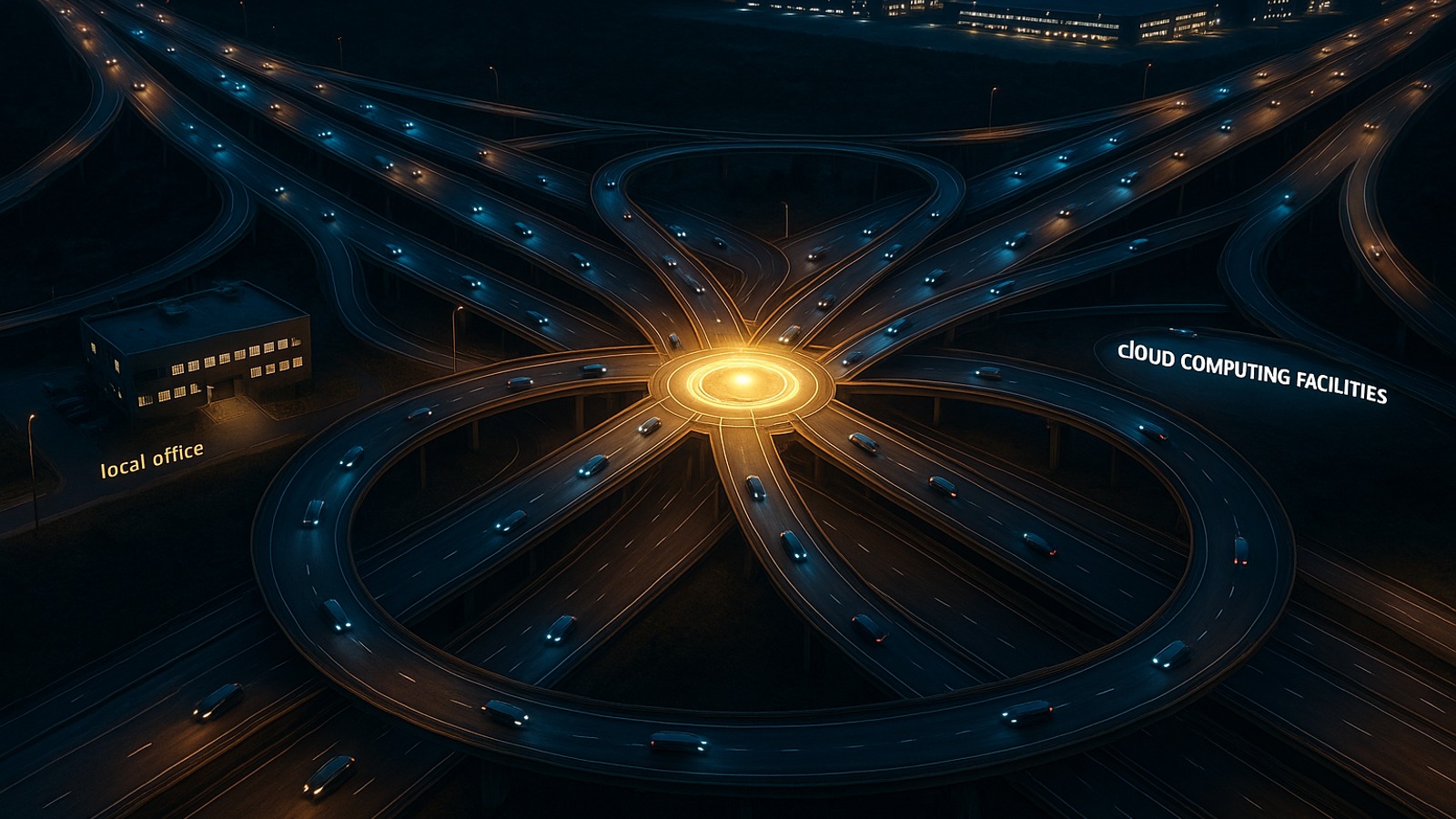
The Rise of Local AI Appliances
You’re already seeing the first version of this today.
When you send a prompt to ChatGPT, Claude, Gemini, Copilot, or an enterprise AI platform, there is increasingly a “router” sitting in front of multiple models deciding where the request should go.
Over the next 3 to 5 years, I think the same architecture will emerge inside companies and even homes.
The Future Is Not One Model
The common assumption is:
User → GPT-6 → Answer
The likely reality is:
User → AI Router → Best Resource → Answer
That resource could be:
- A local model running on your device
- A company-specific model
- A cloud frontier model
- A specialized coding model
- A reasoning model
- A vision model
- A knowledge base retrieval system
The user won’t care which one answered.
⸻
Why Local AI Appliances Become Valuable
Think about what happened with data storage.
Initially:
- Everything lived on local computers.
Then:
- Everything moved to the cloud.
Now:
- We use both.
AI is following the same path.
- Latency
Cloud calls take time.
A local appliance can answer immediately.
Examples:
- Email summarization
- Calendar scheduling
- Document search
- Meeting notes
- Voice assistants
If a local appliance can answer in 0.2 seconds versus a cloud model taking 2 seconds, users notice.
For many tasks, “fast enough” beats “smartest possible.”
⸻
- Cost
This is the biggest driver.
Imagine a business with 500 employees.
If each employee generates:
- 100 AI requests/day
- 22 workdays/month
That’s 1.1 million requests/month.
Many of those requests are simple:
- Summarize this email
- Rewrite this paragraph
- Find this file
- Create a meeting agenda
Running those locally may cost almost nothing after hardware is purchased.
“It’s easier to save a dollar than earn a dollar.”
The CFO will care far more about reducing recurring AI spend than chasing another 2% of model quality.
⸻
- Privacy
Many organizations simply do not want certain information leaving their environment.
Examples:
- Legal documents
- Financial records
- Healthcare information
- Internal strategy
- Source code
A local appliance provides a private inference layer.
This is especially attractive for:
- Hospitals
- Banks
- Defense contractors
- Government agencies
⸻
- Reliability
If the internet goes down:
Cloud AI stops.
Local AI continues.
For manufacturing, logistics, transportation, and field operations, this matters.
Imagine a trucking dispatch office using AI to process bills of lading, permits, and routing.
Losing internet shouldn’t stop operations.
⸻
What AI Appliances Actually Look Like
Most people picture some futuristic robot.
More likely:
- Small rack-mounted servers
- Office appliances
- Enhanced NAS devices
- AI-enabled routers
- AI-capable PCs
Companies like Dell Technologies, HP Inc., Lenovo, and NVIDIA are already positioning around this idea.
The local AI appliance may simply become another piece of office infrastructure.
Just like:
- File server
- Firewall
- Network switch
⸻
The Router Becomes the Most Important Layer
The real value may not be the model.
The value may be the routing system.
Imagine a request:
“Review this contract and tell me if there are unusual indemnification clauses.”
The router could decide:
- Search internal knowledge base.
- Send contract to local legal model.
- Escalate only the hard portions to a frontier model.
- Return combined answer.
The user sees one response.
Underneath, four systems worked together.
⸻
How Routing Decisions Might Work
A future AI router might evaluate:
Factor Route To Simple task Local model Sensitive data Local model High reasoning task Frontier model Coding task Code model Vision task Vision model Real-time internet need Cloud model Cost-sensitive request Local model Mission-critical decision Multiple models
This is already happening in early forms inside major AI systems today.
⸻
Why This Matters for SMBs
For companies in the 50 to 500 employee range, I think the winning architecture looks like:
80% local
- Internal documents
- Policies
- SOPs
- Reporting
- Search
20% cloud
- Deep reasoning
- Research
- Strategy
- Complex coding
- Specialized expertise
Instead of paying for every token generated, businesses will reserve expensive cloud intelligence for problems that actually need it.
⸻
The Investment Thesis
The biggest winners may not be the companies building the smartest model.
They may be the companies that:
- Route requests intelligently
- Manage model selection
- Optimize cost
- Secure private data
- Blend local and cloud resources
In networking, the router became more important than any individual computer attached to it.
AI may be headed toward the same outcome.
The future probably isn’t one giant AI. It’s an AI operating system that decides which intelligence resource should handle each task, balancing speed, cost, privacy, and capability in real time. That shift is exactly why local AI appliances are likely to become more valuable over the next decade.