Ray Kurzweil
Overview
Ray Kurzweil is one of the most influential and polarizing futurists in the AI discourse, an inventor, computer scientist, and author whose decades-long thesis about exponential technological progress has shaped how a generation of technologists think about machine intelligence. He is best known for his "Law of Accelerating Returns," the claim that information technologies advance at exponential rather than linear rates, and for two specific predictions that have become canonical reference points: that AI will reach human-level intelligence by 2029 and that a technological "singularity" — a merging of biological and machine intelligence so transformative it ruptures historical continuity — will occur around 2045. As an inventor, he has a track record few futurists can match: he built the first CCD flat-bed scanner, the first omni-font optical character recognition system, the first print-to-speech reading machine for the blind (in collaboration with the National Federation of the Blind), the first commercially marketed large-vocabulary speech recognition, and the Kurzweil K250 music synthesizer that emulated acoustic instruments. He has been inducted into the National Inventors Hall of Fame and received the U.S. National Medal of Technology, and he co-founded Singularity University with Peter Diamandis in 2008. His worldview blends unapologetic techno-optimism with specific quantitative forecasting, which makes him a touchstone for both AI accelerationists and their critics.
In 2024 Kurzweil released "The Singularity Is Nearer: When We Merge with AI" through Viking, a long-awaited sequel to his 2005 book that argued the past two decades of LLM progress had largely vindicated his timeline. He undertook an extensive media tour through summer 2024, including a marquee Lex Fridman interview, a Joe Rogan appearance, a Diary of a CEO sit-down, and major print coverage in Wired, Time, the Guardian, and the Financial Times. Through 2025 and into 2026 he has remained a Principal Researcher and AI Visionary at Google, having transitioned from his Director of Engineering role, where he focused on natural language understanding and what he calls hybrid cloud-and-neocortex cognition. His public posture on current AI progress is that frontier LLMs are running ahead of his original schedule on language and reasoning while still trailing on embodiment and unified agentic behavior, and that nothing he has seen has caused him to revise either the 2029 or 2045 dates.
Background
- Current Role: Principal Researcher and AI Visionary at Google (since ~2020 transition); Co-founder & Chancellor, Singularity University (founded 2008)
- Notable Roles: Director of Engineering, Google (2012–~2020); Founder of Kurzweil Computer Products (1974, sold to Xerox), Kurzweil Music Systems (1982, sold to Young Chang), Kurzweil Educational Systems, Kurzweil Applied Intelligence, Medical Learning Company, Kurzweil Technologies, and others
- Known For: The Singularity Is Near / Nearer; Law of Accelerating Returns; predictions about AGI by 2029 and singularity by 2045; pioneering work in OCR, speech recognition, music synthesis, and reading machines for the blind; longevity advocacy; Google AI work
- Links: Wikipedia, KurzweilAI.net, Personal site, The Singularity Is Nearer
Key Ideas & Perspectives
The central scaffolding of Kurzweil's worldview is the Law of Accelerating Returns, which he formalized in a 2001 essay and has elaborated across every book since. The claim is that evolutionary processes — and information technology in particular — exhibit double-exponential growth: each generation of technology compresses the time required to develop the next, because the previous generation is itself used to design the successor. He marshals long-run charts of compute-per-dollar, genome-sequencing costs, MRI resolution, and price-performance of integrated circuits to argue that what looks like discontinuous breakthrough is actually a smooth exponential viewed from too close. Critics, including [[Gary Marcus]], argue that he cherry-picks metrics, conflates different technological substrates, and treats curve-fitting as causation; defenders argue that the underlying empirical pattern of compute scaling has held with remarkable fidelity over more than half a century.
The 2029 and 2045 predictions are the part of Kurzweil's framework most often cited and most often misunderstood. Kurzweil has been precise about what 2029 means: an AI that can pass a properly administered, long-form Turing test against expert judges, which he treats as a proxy for human-level general intelligence. He first stated the 2029 date in the late 1990s, well before deep learning's resurgence, and has held it constant for roughly thirty years. Through 2024 and 2025 he has argued that GPT-4-class and successor systems are roughly on schedule for that benchmark, and in his recent media appearances he has said he sees no reason yet to move the date forward, despite peers like [[Dario Amodei]] and [[Sam Altman]] suggesting much shorter horizons. The 2045 singularity date refers to the point at which the cumulative computational power of human-aligned AI exceeds the aggregate computational power of all biological human brains, enabling a phase change in civilization's pace of progress.
A distinctive and underappreciated part of Kurzweil's thinking is his focus on what comes after AGI rather than the moment of arrival. He argues that the decisive event is not machines surpassing humans but humans merging with machines through brain-computer interfaces and, eventually, nanoscale neural augmentation. In "The Singularity Is Nearer" he sketches a near-term path in which non-invasive interfaces and cloud-extended cognition gradually expand human working memory and pattern recognition before more invasive options become medically routine. He couples this with his long-running advocacy for longevity escape velocity — the idea that biomedical progress will, within roughly a decade, add more than a year of life expectancy per calendar year, so that those who reach that threshold can ride medical progress indefinitely. He pursues this personally through an aggressive supplement and monitoring regimen developed with Terry Grossman, documented in his "Fantastic Voyage" and "Transcend" books.
On current LLMs and the path to AGI, Kurzweil's posture in 2024–2026 has been notably steady. He treats transformer-based systems as a powerful but partial implementation of his earlier "pattern recognition theory of mind" from "How to Create a Mind," which proposed that the neocortex is fundamentally a hierarchy of pattern recognizers — a framing now broadly compatible with how researchers describe deep networks. He has expressed admiration for the work of [[Demis Hassabis]] at DeepMind and the trajectory of multimodal models, while flagging that genuine continual learning, robust world models, and embodied common sense remain open. Where he diverges sharply from [[Geoffrey Hinton]] and other prominent doomers is on existential risk: Kurzweil argues that catastrophic outcomes are possible but historically over-weighted in public discussion relative to the more likely benefit case, and he aligns more closely with the broad accelerationist camp around [[Sam Altman]] in believing that the right policy response is to keep building while investing heavily in alignment research, rather than to pause.
His critics, especially [[Gary Marcus]], focus on three lines of attack: that his hit-rate on specific past predictions has been generously self-graded, that exponential extrapolation is not a theory of intelligence, and that his merger-with-AI vision smuggles in metaphysical claims about consciousness it cannot defend. Kurzweil's response — most fully articulated in "The Singularity Is Nearer" and his Lex Fridman appearance — is to argue that being roughly right about a thirty-year arc is more useful than being precisely right about any single year, and that the question of whether uploaded or augmented minds are "really" conscious is empirically tractable rather than philosophically dispositive.
Recent Activity
Articles & Writing
- "The Singularity Is Nearer (excerpt)" (June 2024) — Wired published a major excerpt from the book covering Kurzweil's updated case that exponential compute trends still point to AGI by 2029. Source
- "Ray Kurzweil Still Says He Will Merge with AI" (June 2024) — Time magazine profile around the book launch revisiting his predictions and his Google role. Source
- "Ray Kurzweil on the future of AI" (June 2024) — Guardian long-form interview tied to the UK release of "The Singularity Is Nearer." Source
- NYT coverage of "The Singularity Is Nearer" (June 2024) — review and interview pairing in the New York Times Books and Tech sections. Source
Videos & Talks
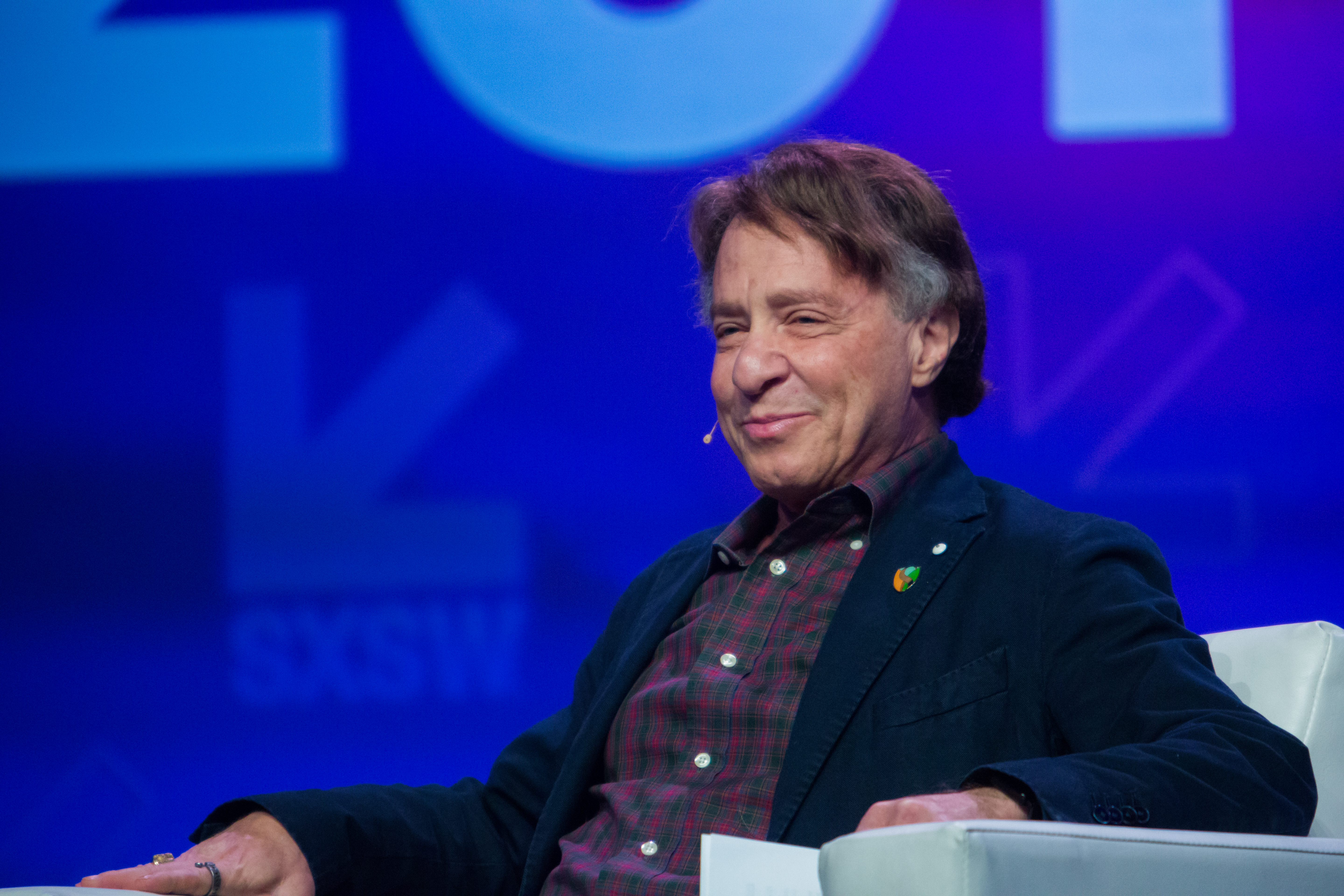
- SXSW 2024 keynote (March 2024) — Kurzweil's annual SXSW appearance previewing the arguments of "The Singularity Is Nearer" months before publication. Source
- TED 2025 conversation (April 2025) — onstage discussion at TED Vancouver on merging with AI and brain-computer interfaces. Source
Podcasts & Interviews
- "Ray Kurzweil: Singularity, Superintelligence, and Immortality" — Lex Fridman Podcast #321 follow-up conversation around the launch of "The Singularity Is Nearer" (June 2024). Long-form discussion of AGI timelines, BCIs, and longevity. Source
- The Joe Rogan Experience #2117 (2024) — Kurzweil's appearance on Rogan during the book tour, covering exponential progress and his personal longevity protocol. Source
- The Peter Diamandis Moonshots podcast (2024–2025) — recurring conversations with his Singularity University co-founder on abundance, longevity, and AI. Source
Books
- "The Singularity Is Nearer: When We Merge with AI" (June 25, 2024, Viking) — sequel to The Singularity Is Near, updating his predictions and analyzing LLM progress through 2024
- "How to Create a Mind: The Secret of Human Thought Revealed" (2012, Viking) — proposes the pattern recognition theory of mind as a blueprint for AGI
- "Transcend: Nine Steps to Living Well Forever" (2009, Rodale, with Terry Grossman) — practical longevity protocol
- "The Singularity Is Near: When Humans Transcend Biology" (2005, Viking) — the canonical statement of the singularity thesis
- "Fantastic Voyage: Live Long Enough to Live Forever" (2004, Rodale, with Terry Grossman) — health and longevity manual
- "The Age of Spiritual Machines: When Computers Exceed Human Intelligence" (1999, Viking) — first detailed timeline of AI milestones through 2099
- "The 10% Solution for a Healthy Life" (1993)
- "The Age of Intelligent Machines" (1990, MIT Press) — first book; introduced many of the themes he would expand for three decades
Last Updated
May 5, 2026