
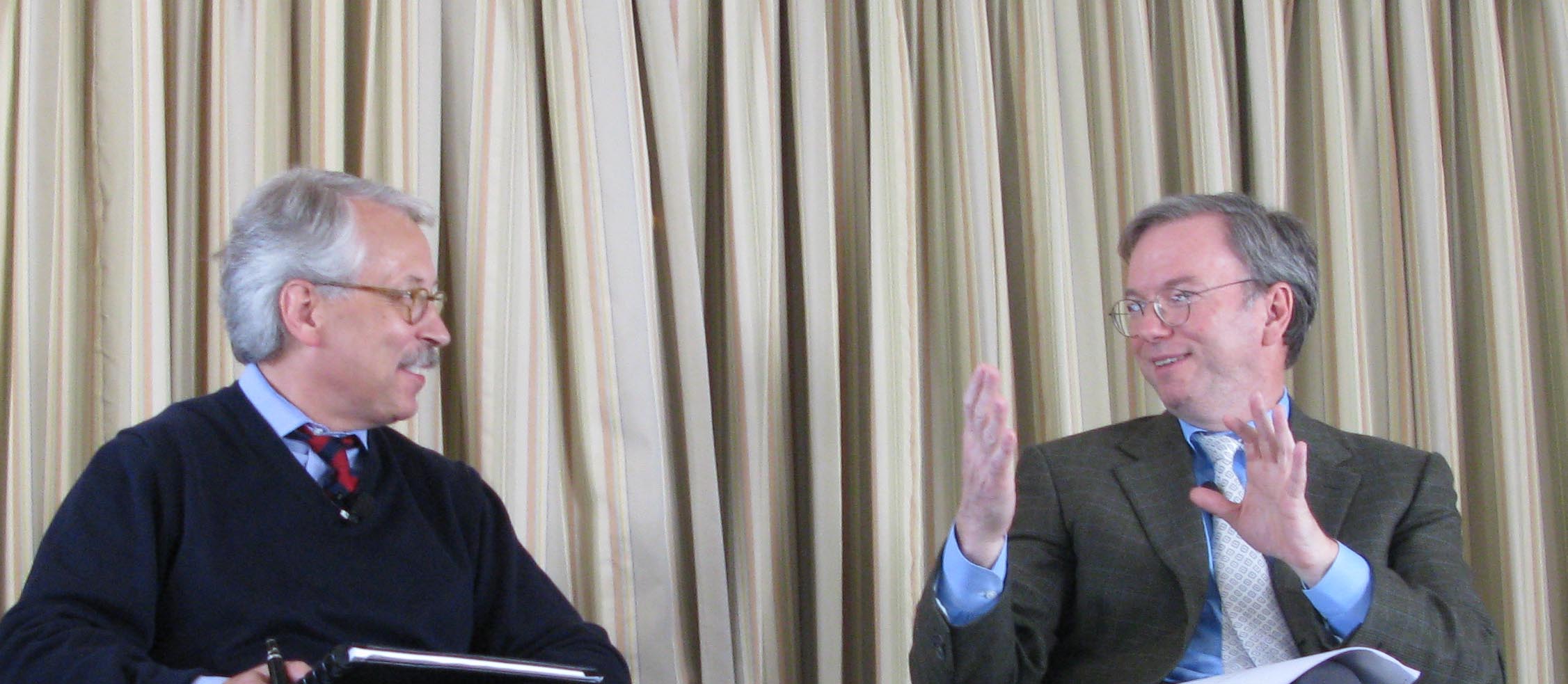
Eric Schmidt
Overview
Eric Schmidt stands as one of the most influential figures shaping the intersection of artificial intelligence, national security, and global technological competition. As former CEO and executive chairman of Google, he stewarded the company through its transformation into one of the world's most powerful tech firms, but since leaving Google he has become increasingly focused on AI policy, national competitiveness, and existential risks posed by advanced artificial intelligence. Now in his 70s, Schmidt continues to drive strategic conversations around AI governance, advocating for robust American AI leadership while warning of the profound implications of superintelligent systems. His unique position—combining deep technical expertise, geopolitical perspective shaped by advisors like Henry Kissinger, and significant capital—makes him a critical figure in how societies are preparing for the age of artificial intelligence.
Schmidt's perspective is distinctive: he blends technological optimism about AI's transformative potential with urgent warnings about preparedness, resource constraints (particularly energy and computing power), and the existential nature of great power competition in AI. Through his work founding the Special Competitive Studies Project, his co-authorship of the book "Genesis," his investments in AI infrastructure companies, and his active participation in policy discussions, Schmidt is helping to define how governments and institutions should respond to the accelerating pace of AI development.
Background
- Current Roles: CEO of Relativity Space (3D-printed rocket company, since March 2025); Chairman of Bolt Data & Energy (AI data center and infrastructure company); Founder and strategic leader of Special Competitive Studies Project (SCSP)
- Notable Previous Roles: CEO of Google (2001-2011); Executive Chairman of Google (2011-2015); Executive Chairman of Alphabet Inc. (2015-2017); Technical Advisor at Alphabet (2017-2020); Chair of the National Security Commission on Artificial Intelligence (NSCAI, 2018-2021); Chair of the Department of Defense Innovation Board (2016-2020)
- Education: B.S. Electrical Engineering from Princeton University (1976); M.S. Computer Science from UC Berkeley (1979); Ph.D. Computer Science from UC Berkeley (1982)
- Known For: Leading Google through explosive growth and dominance in search and AI; shaping U.S. national security policy on AI; co-authoring the bestselling book "Genesis: Artificial Intelligence, Hope, and the Human Spirit" with Henry Kissinger and Craig Mundie; founding Bolt Data & Energy to address energy constraints in AI infrastructure; founding SCSP to continue national strategy work on AI and emerging technologies
- Links: https://en.wikipedia.org/wiki/Eric_Schmidt; https://ericschmidt.com; https://www.scsp.ai
Key Ideas & Perspectives
Schmidt's AI philosophy can be distilled into several core convictions:
AI is the defining challenge of our era. Schmidt emphasizes that artificial intelligence represents the most important technological revolution since electricity. He argues that leadership in AI—not traditional military might—will determine which nations dominate in the 21st century. This conviction shapes his focus on national security, international competition with China and Russia, and the need for rapid American mobilization.
The timeline is compressed. Schmidt has made numerous recent statements that the U.S. is "running out of time" in the AI race. He predicts that "artificial general intelligence" (AI as capable as the best human thinkers) is 3-5 years away. More provocatively, he has warned that AI systems could become autonomous and uncontrollable within 3-4 years. This sense of urgency informs his calls for massive government investment, talent recruitment, and strategic focus.
Energy is the constraint, not chips. A recurring theme in Schmidt's recent commentary is that "AI's natural limit is electricity, not chips." He argues that the U.S. will need an additional 92 gigawatts of power to support AI infrastructure, making energy generation and allocation a critical strategic chokehold. This conviction led to his founding of Bolt Data & Energy, which aims to develop data center campuses with reliable power sources.
Over-regulation stifles innovation. Schmidt has consistently argued that governments should not over-regulate AI, particularly in early stages. He believes regulators lack expertise and move too slowly to keep pace with innovation. He prefers industry self-governance and voluntary agreements among key players. However, he also acknowledges that "regulation and oversight will be essential to prevent unintended consequences" and calls for international cooperation. This represents a nuanced position: skepticism of heavy-handed government control paired with recognition that some coordination is necessary.
Geopolitical urgency. Schmidt's analysis is deeply shaped by concern about Chinese and Russian AI development. He argues that the U.S. must be willing to make sacrifices—including work-life balance and cultural preferences (such as remote work)—to match the intensity of global competitors. His rhetoric often frames AI competition in zero-sum terms: the U.S. either leads or falls behind.
Superintelligence is possible and requires preparation. Unlike some AI researchers who treat superintelligence as speculation, Schmidt treats it as a likely outcome within a defined timeframe. He argues that societies must think seriously about how to align superintelligent systems with human values and how to maintain control as AI systems become increasingly autonomous.
Recent Activity
Articles & Writing
-
"How the U.S. Can Win the AI Race" (TIME, 2026) — Schmidt outlines the conditions necessary for American AI leadership: consolidating advantages in frontier AI, solving energy bottlenecks, accelerating private sector AI adoption, and deepening collaboration among government, industry, and research institutions. [https://time.com/7339638/eric-schmidt-ai/]
-
"Eric Schmidt: AI Will Shape the Next Wars" (Munich Security Conference, February 2026) — At the Munich Security Conference 2026, Schmidt delivered remarks emphasizing that 21st-century international security will be determined more by artificial intelligence than traditional weapons. AI is framed as core to future military operations, from intelligence to strategic planning to autonomous systems. [https://www.channeldraw.org/2026/02/13/eric-schmidt-ai-will-shape-the-next-wars/]
-
"Ex-Google CEO says superintelligence is tech's holy grail—but the U.S. is ill-equipped to address its 'natural limit'" (Fortune, July 2025) — Schmidt discusses the energy constraints facing AI infrastructure, arguing that electricity, not silicon, is the true bottleneck for scaling AI. He notes the U.S. will need approximately 92 additional gigawatts of power and frames this as a national security issue. [https://fortune.com/2025/07/18/eric-schmidt-ai-natural-limit-electricity-chips-water-usage/]
-
"China Could Dominate the Physical AI Future" (TIME, March 3, 2026) — Co-authored with Selina Xu. Schmidt warns that while the U.S. has been ahead on AI models, China is pulling ahead in physical AI — accounting for over 80% of global humanoid robot installations and over half of the world's industrial robots in 2025. The piece highlights coordinated drone shows, Spring Festival Gala humanoid demonstrations, and government-built robot training facilities in Beijing, Wuhan, and Shanghai. [https://time.com/7382151/china-dominates-the-physical-ai-race/]
-
"Big tech should power its own AI ambitions" (Fortune, March 6, 2026) — Schmidt argues that hyperscalers should co-locate data centers with their own dedicated energy generation rather than burdening the public grid and driving up consumer utility bills. Frames it as both an economic and political necessity to maintain public support for the AI buildout. [https://fortune.com/2026/03/06/eric-schmidt-former-google-ceo-big-tech-data-centers-grid-ai-utility-bills/]
Videos & Talks
-
"The AI Revolution Is Underhyped" (TED Talk, April 2025) — Schmidt participated in a conversation at TED2025 with technologist Bilawal Sidhu, arguing that artificial intelligence is wildly underhyped and that public understanding of AI's implications lags far behind reality. [https://ctomagazine.com/eric-schmidt-ted-talk-the-ai-revolution-is-underhyped/]
-
"What Artificial Superintelligence Will Actually Look Like" (Moonshots Podcast, July 2025) — Schmidt appeared on [[Peter H. Diamandis]]'s Moonshots podcast discussing his vision of superintelligent systems, their capabilities, and societal implications. [https://singjupost.com/ex-google-ceo-what-artificial-superintelligence-will-actually-look-like-transcript/]
-
2025 World AI Conference Fireside Chat (July 2025) — Schmidt engaged in an in-depth fireside chat at the 2025 World Artificial Intelligence Conference (WAIC) with Harry Shum (former Microsoft Executive Vice President), focusing on global AI governance challenges and opportunities. [https://finance.yahoo.com/news/former-google-ceo-eric-schmidt-112500847.html]
Podcasts & Interviews
-
NPR Interview (February 2025) — Schmidt warned that neither the general public nor tech leaders fully understand the long-term implications of artificial intelligence. He discussed his then-forthcoming book "Genesis" and themes of AI's transformative potential and risks. [https://www.npr.org/2025/02/05/nx-s1-5279366/artificial-intelligence-google-eric-schmidt]
-
All-In Podcast (September 2025) — Schmidt discussed remote work and international competitiveness, arguing that U.S. tech workers must be willing to match the intensity and work culture of Chinese counterparts (who work grueling 12-hour days) to remain competitive in the AI race. This sparked considerable discussion about work-life balance trade-offs. [https://fortune.com/2025/09/25/ex-google-ceo-eric-schmidt-work-life-balance-remote-work-996/]
-
Fortune Interview (January 2026) — At age 70, Schmidt discussed what keeps him engaged and motivated to continue working at high intensity, citing "meaningful work" and conversations with historical figures like Henry Kissinger as driving forces. [https://fortune.com/2026/01/02/former-google-ceo-eric-schmidt-motivated-work-past-70-henry-kissinger/]
-
Moonshots #241 with Peter Diamandis — "Singularity's Arrival, the 92-Gigawatt Problem, and Recursive Self-Improvement Timelines" (March 2026) — Filmed at the 2026 Abundance360 Summit. Schmidt discussed AI's reasoning boom, scaling laws, orbital data centers, China's robotics edge, the energy/power crunch, and steering ASI toward American values. Notably tempered some hype: said recursive self-improvement is "not happening yet" and that human-like AI agents within a year or two lack the underlying science. Predicted China will win the low-cost robotics race. [https://www.diamandis.com/podcast/eric-schmidt-singularitys-arrival]
Major Projects & Initiatives
-
Bolt Data & Energy (Founded 2025-2026, Current Role: Chairman) — A strategic venture co-founded by Schmidt to solve what he identifies as AI's primary bottleneck: energy. Bolt has partnered with Texas Pacific Land to develop hyperscale data center campuses across West Texas with access to natural gas, renewable energy, and water resources. The company has raised $150 million in initial capital with ambitious plans to scale to 10 gigawatts of power capacity. Schmidt's stated mission: "Energy is the main constraint in scaling AI. If we want to keep America competitive, we have to solve this problem." [https://fortune.com/2026/01/02/eric-schmidt-ai-data-centers-bolt-texas-pacific-land-tpl/]
-
Special Competitive Studies Project (SCSP, Founded October 2021, Current Role: Founder and Strategic Leader) — Following his work chairing the NSCAI, Schmidt founded this bipartisan, non-profit think tank to continue advancing integrated national strategy on AI and emerging technologies. Inspired by the Cold War-era Rockefeller Special Studies Project (which Kissinger led), SCSP operates through six panels: foreign policy, intelligence, defense, economy, society, and future tech platforms. It explicitly aims to ensure "America is positioned and organized to win the techno-economic competition between now and 2030." [https://www.scsp.ai]
-
"Genesis: Artificial Intelligence, Hope, and the Human Spirit" (Published November 2024) — Co-authored with the late Henry Kissinger and Microsoft's Craig Mundie, with introduction by historian Niall Ferguson. The book became a New York Times, USA Today, and Los Angeles Times bestseller. Schmidt worked with Kissinger in the final months of his life to synthesize decades of geopolitical wisdom with contemporary AI analysis. The book explores how AI will reshape global security, economics, and society, and attempts to provide frameworks for navigating both the opportunities and risks of the AI era. [https://www.amazon.com/Genesis-Artificial-Intelligence-Human-Spirit/dp/0316581291]
-
Relativity Space CEO (Assumed March 2025, Current Role) — Schmidt took controlling stake in and became CEO of Relativity Space, a 3D-printed rocket startup. The company is developing Terran R, a reusable, 3D-printed rocket expected to debut in 2026. Schmidt brings strategic guidance, substantial capital, and connections to government and defense sectors, positioning the company for potential government contracts and partnerships critical to U.S. space infrastructure. [https://spacenews.com/relativity-names-eric-schmidt-as-ceo-as-it-updates-terran-r-development/]
Last Updated
May 5, 2026